THE OIL ATLAS · Private preview
Extra virgin olive oil
Overview
The highest-grade virgin olive oil obtained solely by mechanical or other physical means from olive fruit. It must meet chemical and sensory requirements; free acidity must not exceed 0.80 g per 100 g, expressed as oleic acid.
Source material
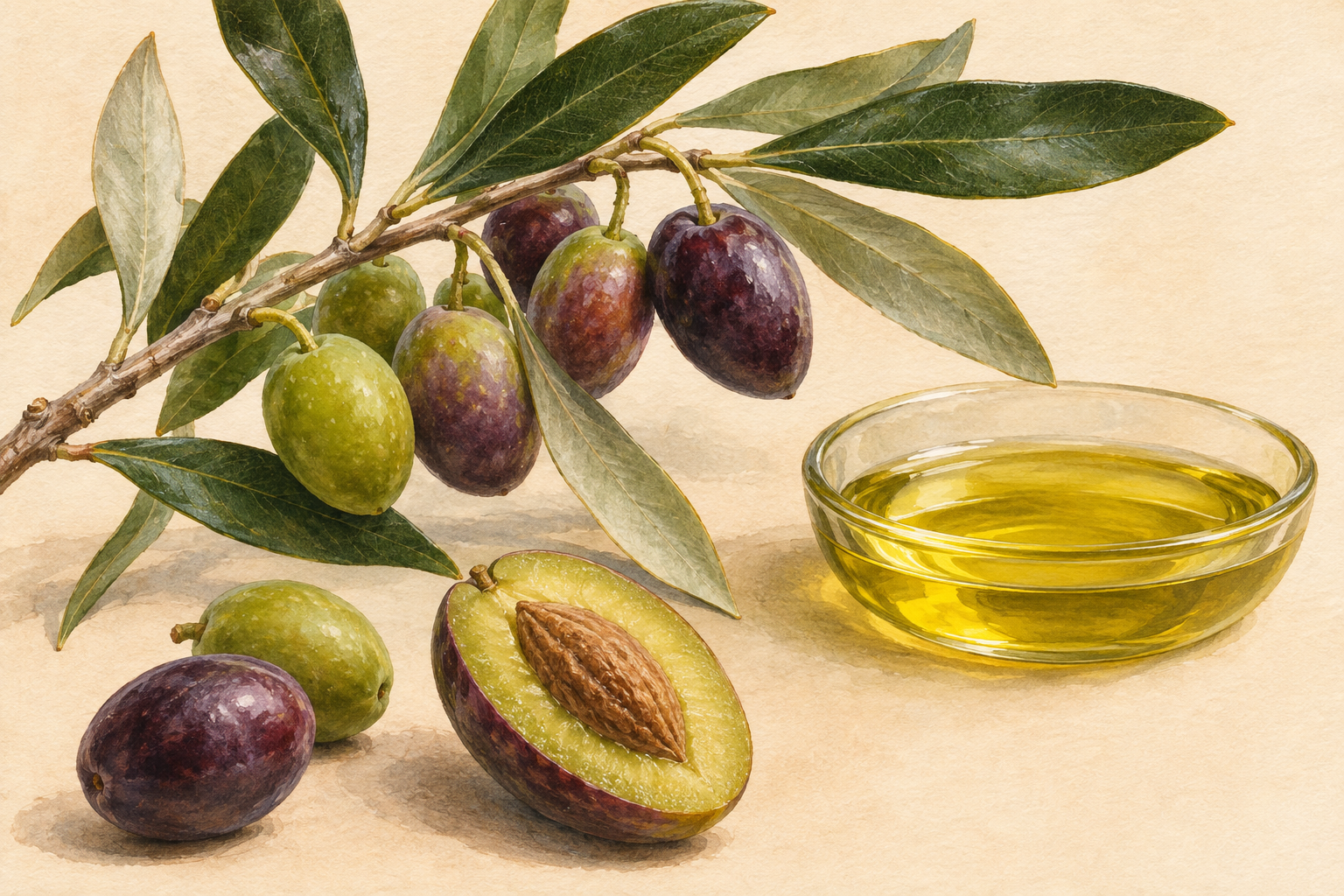
Fruit of the olive tree (Olea europaea L.). This is not an oil extracted only from the seed: the oil is recovered from the fruit, including its fleshy portion.
Composition
| Measure | Requirement or characteristic | Basis and unit |
|---|---|---|
| Free acidity | No more than 0.80 | g oleic acid per 100 g oil; IOC grade limit, not a fatty-acid composition percentage |
| Fatty acids | Oleic acid is predominant | Varies by cultivar, origin and harvest; no unsupported single percentage is given |
Region
Spain, Italy and Greece are among the major Mediterranean producers and consumers. The IOC extra-virgin designation is a quality grade, not a guarantee of origin from any particular country.
Food use
Used on salads, beans, roasted vegetables and bread, and to finish dishes. Bitterness and a peppery sensation in the throat can be normal sensory characteristics rather than defects. It can also be used in cooking, but adding it at the end highlights aroma.
Extraction
Olives are cleaned and crushed; oil is recovered through malaxation and separation, often centrifugation. IOC virgin oils may undergo no treatment other than washing, decantation, centrifugation and filtration.
Safety
The IOC free-acidity limit of 0.80 g per 100 g, expressed as oleic acid, is a quality measure, not a statement that the oil tastes sour. Keep tightly closed away from heat and light, and watch for changes in aroma and quality after opening.
Sources
International Olive Council, Trade Standard Applying to Olive Oils and Olive Pomace Oils, COI/T.15/NC No 3/Rev.21 (July 2025). https://www.internationaloliveoil.org/wp-content/uploads/2025/07/TRADE-STANDARD-REV-21_EN.pdf International Olive Council, Olive oils: designations and definitions. https://www.internationaloliveoil.org/olive-world/olive-oil/