THE OIL ATLAS · Private preview
Canola oil
Overview
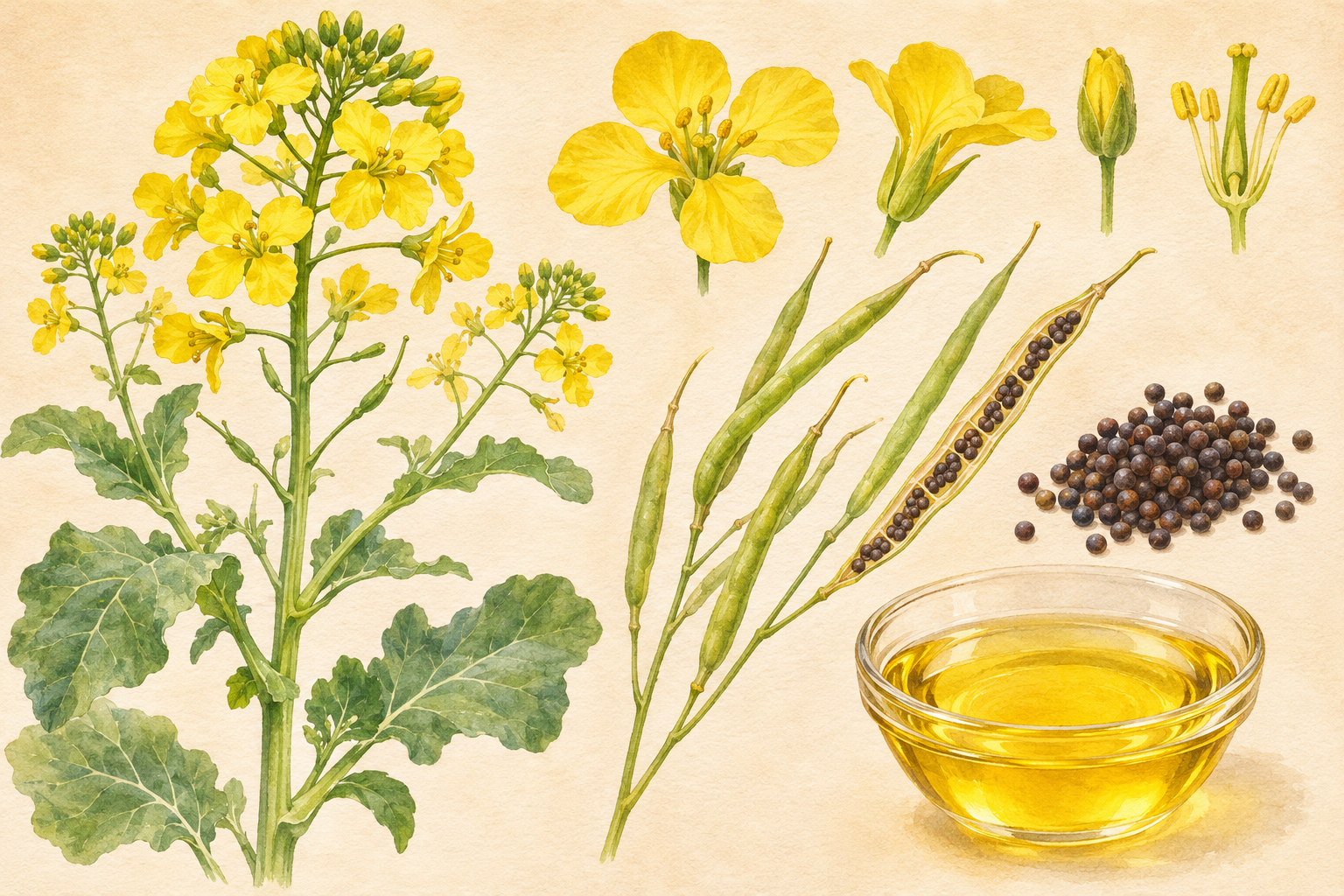
An edible oil separated from low-erucic rapeseed. Refined canola oil has a relatively mild flavour and is used in home cooking, frying, dressings, baking and processed foods. It is a different compositional category from high-erucic rapeseed oil.
Source material
Seeds of low-erucic cultivars derived from Brassica napus, B. rapa and B. juncea. Canola is not a single botanical species. The oil is extracted from these seeds, rather than eaten as whole seed.
Composition
| Measure | Value or characteristic | Material, conditions and source |
|---|---|---|
| Erucic acid (C22:1) | No more than 2% | Codex low-erucic rapeseed-oil category; percentage of total fatty acids. Codex CXS 210-1999 / CFIA |
| Saturated fatty acids | Less than 7% | General characteristic of Canadian canola oil described by the Canadian Grain Commission; percentage of total fatty acids, not a guarantee for every product |
| Principal unsaturated fatty acids | Oleic acid is the major monounsaturated fatty acid; linoleic and alpha-linolenic acids are also present | Canadian Grain Commission discussion and analytical methods; cultivar and growing environment affect composition |
Region
Canola oil is a major household cooking oil in Canada, where seed is crushed and refined at domestic processing plants. It also supplies food markets including the United States. Canadian labelling guidance accepts oil from low-erucic Brassica juncea under the name canola oil. This does not mean that all historical rapeseed oils were canola.
Food use
Refined canola oil is used for sautéing and frying in homes and restaurants. Food manufacturers use it in salad dressings, margarines, shortenings and baked goods. These are uses of the separated oil, not evidence based merely on eating rapeseed.
Extraction
A common Canadian industrial route cleans, heats and flakes the seed, then recovers oil by pressing. Solvent extraction may recover additional oil from the presscake. Refining removes gums, free fatty acids, pigments and odorous constituents to yield cooking oil. Cold-pressed products follow different processing routes; not every product undergoes the same steps.
Safety
Choose food-grade low-erucic oil and do not confuse it with high-erucic rapeseed oils intended for other uses. The 2% erucic-acid limit is a compositional threshold relative to total fatty acids, not a serving-size recommendation. Follow the label after opening, keep the container closed and away from heat and light, and discard rancid or repeatedly overheated oil.
Sources
1. Canadian Food Inspection Agency, Labelling requirements for fats and oils. 2. Canadian Grain Commission, Oilseeds methods and tests used to measure quality. 3. U.S. 21 CFR §184.1555, Rapeseed oil. 4. Canola Council of Canada, Processing canola seed into oil and meal. 5. Canola Council of Canada, Canola industry in Canada. 6. Codex CXS 210-1999, Standard for Named Vegetable Oils (FAO-hosted text).