THE OIL ATLAS · Private preview
Rice bran oil
Overview
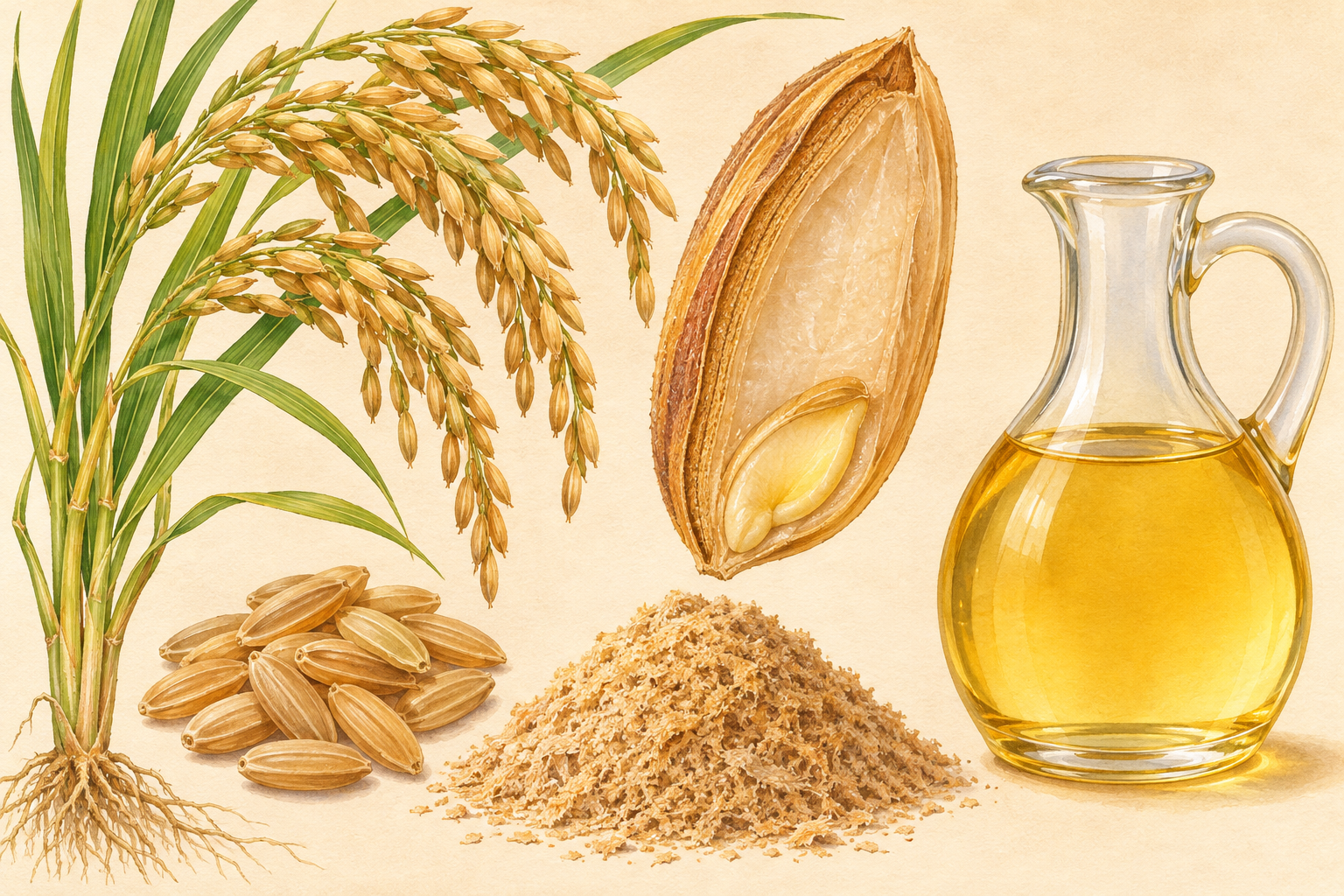
Rice bran oil is a separated edible oil recovered from the milling fraction of rice. Refined products have a relatively mild flavour and are used in everyday cooking.
Source material
The source is bran from rice (Oryza sativa), including germ material removed during milling; it is not oil pressed from intact rice grains.
The feedstock is rice bran and germ generated during the milling of brown rice. The oil is not pressed from polished white rice. Because bran lipids can deteriorate during handling, management of the material before extraction matters for finished-oil quality.
Composition
Codex CXS 210-1999 recognises rice bran oil as a distinct named oil. Its reference range of 0.9–2.1% gamma-oryzanols applies to crude oil and is not a guaranteed concentration in refined products. Refining changes the amounts of retained minor components.
Codex fatty-acid composition (gas–liquid chromatography of authentic oil samples; % of total fatty acids)
| Fatty acid | Range (%) |
|---|---|
| Palmitic acid (C16:0) | 14–23 |
| Oleic acid (C18:1) | 38–48 |
| Linoleic acid (C18:2) | 21–42 |
| Alpha-linolenic acid (C18:3) | 0.1–2.9 |
These are reference ranges for oil identity, not guaranteed values for a particular retail bottle or grams per 100 g of finished oil.
Food use
Refined rice bran oil is used for stir-frying, deep-frying and general cooking, and as an oil ingredient in manufactured foods. FAO explicitly describes refined rice bran oil as a cooking oil and food-manufacturing ingredient. Its relatively mild flavour suits dishes where the ingredients should remain prominent.
Extraction
Bran may be stabilised before pressing or solvent extraction. Food-grade oil may then undergo degumming, neutralisation, bleaching and deodorisation.
Fresh bran can deteriorate rapidly after milling, making stabilization before extraction an important processing step.
Safety
Choose a product refined and labelled for food use. FAO also records industrial uses of crude rice bran oil, which must not be confused with refined edible oil. Limit exposure to heat, light and air and follow product instructions for storage and heating. Gamma-oryzanol content should not be presented as a guarantee of disease prevention.
Sources
FAO, Minor Oil Crops: Rice bran, https://www.fao.org/4/X5043E/x5043E0a.htm ; Codex CXS 210-1999, Named Vegetable Oils; Pal & Pratap (2017), Journal of Oleo Science, DOI:10.5650/jos.ess17061.
Region
In Japan, rice bran has been processed into edible oil as a by-product of rice milling. An FAO monograph documents production and food use of rice bran oil in Japan and refined edible-oil production in India. This is evidence for use of the separated oil, not simply for eating rice bran.